What is a CAP?
Corrective Action is a phrase frequently refers to a continuous improvement process known as Corrective Action Plans (CAP). CAP is recognized by government regulators and business organizations as means to improve by willfully identifying deviations from the expected so that they may be investigated and corrected to eliminate a recurrence or at least be better prepared to prevent adverse consequences should a similar condition arise.
Corrective Action Plan (CAP)
What Is a Corrective Action Plan?
A Corrective Action Plan, or CAP, is what happens after a real problem, such as a violation of law, statute, contract, or ethics, has been identified by a citizen or a leader and government needs to fix it in a way that keeps it from happening again.
A CAP is more than correcting the immediate problem. It asks:
- What happened?
- Why did it happen?
- What needs to change?
- Who is responsible for making that change?
- How will we know the correction worked?
- What will keep the problem from happening again?
That is the purpose of corrective action.
Where Does a CAP Fit in Our Proposal?
A citizen raising a concern does not automatically mean something is wrong, and it does not automatically trigger a CAP.
First, the concern needs to be reviewed by a Compliance Officer to determine whether it involves a true violation of law, statute, contract enforcement of terms, ethics requirements, policy, procedure, internal controls, or other governance obligations.
The concern first needs to be received, tracked, and reviewed. 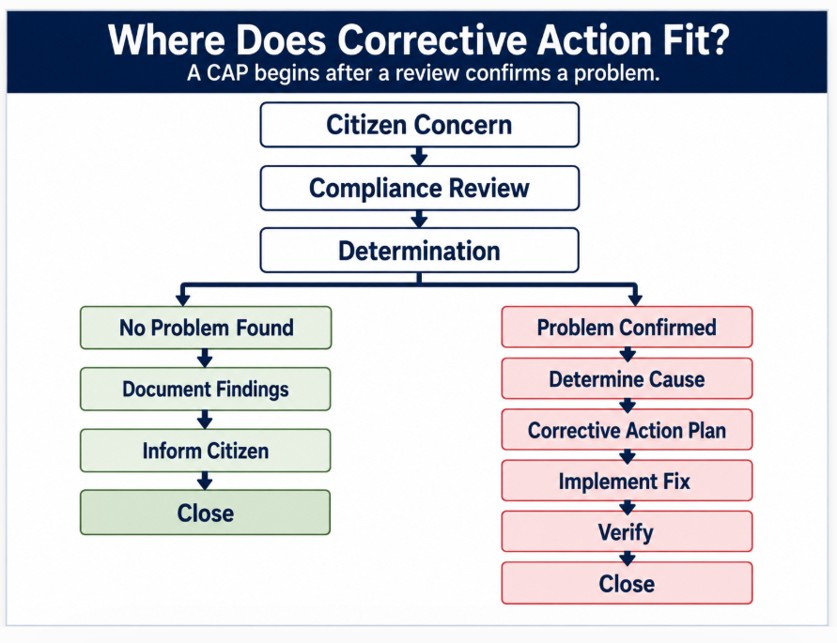 Process Steps

Initial Review - Applied to All Citizen Concerns
First - Citizen Concern
A citizen submits their concern into a formal process.
Second- Compliance Review
If the Compliance Review determines there is no violation or deficiency, the findings should be documented, communicated to the citizen and the matter closed.
Third - Determination
There is a branch at this step, depending on the results of the Compliance Review.
- If no violation or deficiency exits, then provide feedback to the citizen and close out the concern.
- If there is a violation or deficiency, then investigate the concern.
Feedback to Citizen - Applied to concerns that were NOT violations or deficiencies
Document the determination of the condition, explain why it was or wasn't a violation or deficiency. The concern is closed out, meaning no further action is required. However, the concern remains in a tracking database, which may be referred to later when addressing other similar or related citizen concerns.
Resolve the Concern - Applied to concerns that were violations or defiencies
Why did it happen, and what needs to be done to correct it? That is where corrective action begins.
First - State the Problem
The citizen's description of the concern may not be precise enough to determine what needs to be fixed. After the problem is confirmed, the citizen's concern may be restated to stay focused on the source of the violation or deficiency, so effective corrective actions can be implemented.
Second - Determine the Cause
Determine the cause of the violation or deficiency. Some investigation will be necessary to determine why the violation or deficiency occurred. Extra investigative effort is need for significant violations or deficiencies so effective corrective actions can be developed.
Some typical insights to the cause are as follows:
- But why was it missed?
- Was the procedure unclear?
- Was responsibility never assigned?
- Was training inadequate?
- Was there no control to catch the error?
- Did a contract requirement fail to clearly define what was expected?
CAP looks beyond the immediate correction and addresses the cause of the violation or deficiency so it does it recur or the risk of recurrence can be better managed.
Third - Corrective Action Plan
Develop Corrective Action Plan(s) to fix the cause.
There is an important distinction between the correction of the immediate problem and a corrective action plan, which addresses the organizational cause. Corrective Action Plans are like a project plan that manages the reason the problem happened, so it is less likely to happen again. It is oversight.

Remember, CAP is an acronym and "P" stands for "Plan." CAP should be written as a plan, which should include the following attributes:
- The problem — What requirement or expectation was not met?
- The cause — Why did it happen?
- The corrective action — What will change?
- The owner — Who is responsible for completing it?
- The completion date — When should it be done?
Fourth - Implement the Fix
Fifth - Verify the Fix
Sixth - Close
Origin
CAP became a regulatory requirement following the Sarbanes-Oxley Act of 2002 (SOX), enacted after accounting scandals at Enron, WorldCom, and others.
Application to Government
While CAP originated in the financial sector, its methodology applies to any organization needing structured accountability — including government entities.